
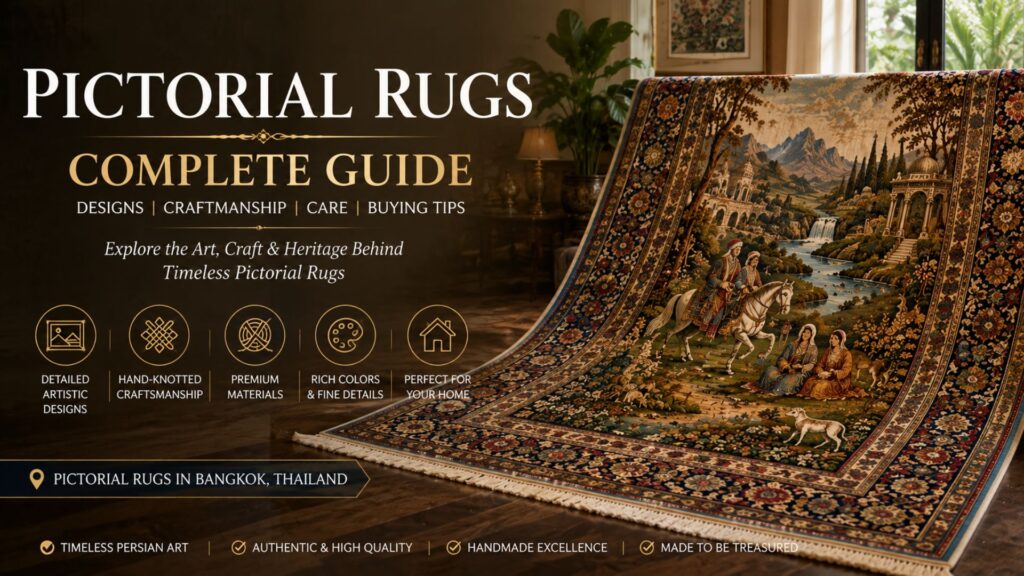
Pictorial rugs are more than floor coverings. They combine traditional rug-making techniques with detailed artistic imagery, allowing a rug to tell a story through portraits, landscapes, animals, flowers, historical scenes, or other decorative compositions.
Unlike rugs built mainly around repeating geometric patterns, pictorial rugs are designed to make the artwork itself the central visual element. Depending on the design and construction, they can become a distinctive focal point in a living room, study, bedroom, or other interior space.
For anyone considering a pictorial rug, understanding its design, materials, craftsmanship, size, authenticity, and care requirements can make the buying decision much easier. This guide explains what pictorial rugs are, what makes them unique, how to choose one, and what to consider when buying a rug in Bangkok or elsewhere in Thailand.
Pictorial rugs are rugs featuring visual scenes or artistic imagery as the main design rather than relying primarily on repeating geometric or abstract patterns. Their designs may depict people, animals, landscapes, flowers, architecture, historical subjects, nature, poetry, or other artistic themes.
Some Persian pictorial rugs are particularly well known for incorporating detailed scenes inspired by Persian art and culture. However, not every pictorial rug is necessarily Persian or made in Iran. The origin, materials, construction, and artistic style can vary from one rug to another.
Pictorial carpets are often appreciated because the rug functions as both a textile and a piece of decorative art. The level of detail can vary considerably, from relatively simple compositions to highly intricate scenes requiring considerable craftsmanship.
The appeal of unique pictorial rugs comes from their ability to combine decorative function with visual storytelling. Several characteristics can distinguish them from conventional patterned rugs.
Pictorial rug designs can contain a wide range of imagery, including portraits, landscapes, animals, flowers, architectural scenes, and historical subjects.
Creating recognizable imagery in a woven or knotted textile requires careful planning and technical skill. Fine details need to be represented within the structure of the rug, while borders, backgrounds, colors, and individual elements must work together as a balanced composition.
For this reason, detailed Persian rug designs can be appreciated not only for their decorative value but also for the craftsmanship involved in producing them.
Some Persian pictorial rugs draw inspiration from traditional Persian art, culture, nature, poetry, and historical imagery.
A rug may represent a particular scene, character, landscape, or symbolic theme. These designs can give the piece a cultural and artistic dimension that goes beyond its role as a floor covering.
Persian carpet designs have developed through a long tradition of decorative and artistic expression, and pictorial rugs represent one way in which that tradition can be expressed through imagery.
Many hand-knotted pictorial rugs require skilled craftsmanship because the design is created through individual knots rather than simply being printed onto the surface.
The level of detail that can be achieved depends on factors such as knotting technique, materials, design planning, and the skill of the maker. Handmade Persian rugs can therefore have variations that are part of their individual character.
If you want to understand more about the construction of hand-knotted rugs, see our guide to hand-knotted Persian rugs.
It is also useful to understand the difference between handmade construction and machine production when evaluating a rug.
The material used in a pictorial rug affects its appearance, texture, durability, and ability to reproduce fine details.
Wool pictorial rugs are valued for their durability and practical qualities, making wool a common material for rugs intended for regular use.
Silk pictorial rugs generally have a finer and smoother appearance. Silk can also support detailed imagery and subtle visual variations, which can be useful for highly intricate designs.
Some rugs may use a combination of materials. Therefore, buyers should always check the specific construction and material composition of an individual rug rather than assuming that every Persian pictorial rug uses the same materials.
Color plays an important role in the appearance of pictorial rugs. It can help create depth, contrast, highlights, shadows, and visual separation between different elements of a scene.
For example, carefully selected colors can help distinguish facial details, landscape features, flowers, architectural elements, or other parts of a composition.
The overall combination of pictorial rug colors should also work with the surrounding interior. A detailed rug can contain many colors, but the final effect should still feel balanced within the room.
Choosing the right rug involves more than finding an attractive image. Buyers should consider the rug’s size, design, materials, craftsmanship, authenticity, and relationship with the interior.
The size of a pictorial rug should be appropriate for the room and furniture arrangement.
Before buying, measure the available area and consider:
A highly detailed pictorial area rug may need enough surrounding space for its artwork to remain visible. If furniture covers too much of the design, some of the visual impact may be lost.
Large pictorial rugs can work particularly well in spacious rooms where the full composition can be appreciated.
Pictorial rugs can work with different interior styles, but the design should complement the existing space.
In a modern interior, a detailed rug can act as a statement piece against simpler furniture and neutral surfaces. In a classic or traditional interior, a pictorial rug may complement other decorative elements more naturally.
When selecting a rug, consider:
For a living room, consider how much of the rug will remain visible after placing sofas, tables, and chairs.
Quality should be evaluated carefully, particularly when considering fine pictorial rugs or premium Persian carpets.
Look at:
Rug knot density can provide useful information about construction and potential detail, but it should not be treated as the only measure of quality. Materials, craftsmanship, design execution, condition, and construction all matter.
If you are comparing handmade and machine-produced rugs, understanding their construction differences can help you make a more informed decision. Our guide on hand-knotted vs machine-made rugs can provide additional context.
When shopping for authentic pictorial rugs, do not rely only on the label used by a seller.
Consider:
The term “Persian rug” should not automatically be treated as proof that a rug was made in Iran. Buyers should examine the available information and ask questions when the origin is important to their purchase.
For additional guidance, read our article on how to identify authentic Persian rugs.
Proper care can help maintain the appearance and condition of a pictorial rug.
Basic pictorial rug care includes:
Different handmade rugs can vary significantly depending on their material, construction, age, and condition. Therefore, there is no single Persian rug cleaning method that is appropriate for every rug.
For valuable or delicate handmade rugs, professional advice can help reduce the risk of damaging fibers, dyes, or construction.
Pictorial rugs can be used in a wide range of interiors in Thailand, but the local environment should be considered when selecting and caring for one.
Room design, humidity, sunlight, placement, and cleaning routines can all affect how a rug performs over time.
Before purchasing pictorial rugs in Thailand, consider where the rug will be placed and how much exposure it will receive. Areas with strong sunlight may require additional attention to reduce prolonged exposure. Similarly, rugs in frequently used spaces may need a material and construction suitable for the level of foot traffic.
Interior style is another important consideration. A pictorial rug can work as a focal point in a contemporary Bangkok apartment, a traditional home, a study, or a larger luxury interior, depending on its size and design.
For customers searching for pictorial rugs Bangkok, choosing a specialist rug gallery can make it easier to compare designs, materials, craftsmanship, and sizes in person.
Safa Carpet Gallery offers customers in Bangkok an opportunity to explore Persian rugs, handmade rugs, and different decorative styles in a physical gallery setting.
The gallery is located at:
5 Soi Prom Sri 1, Sukhumvit 39, Klongtoey Nue, Watthana, Bangkok 10110, Thailand
If you are searching for a Persian carpet Bangkok shoppers can view in person, visiting a specialist gallery can be useful because you can examine the rug’s colors, texture, construction, size, and overall appearance directly.
Choosing a pictorial rug is a personal decision because the design needs to work with both your taste and your interior.
Safa Carpet Gallery provides customers with an opportunity to explore a selection of Persian rugs and handmade rugs in Bangkok.
Customers can consider factors such as:
Rather than selecting a rug based only on photographs, seeing a rug in person can help you understand its colors, texture, proportions, and visual effect within a real space.
Pictorial rugs are rugs featuring artistic images or scenes such as portraits, landscapes, animals, flowers, architecture, historical subjects, or cultural themes. Unlike rugs dominated by repeating patterns, pictorial rugs use imagery as a central part of the design.
Many pictorial rugs are handmade and may be hand-knotted, but not every pictorial rug is necessarily handmade. Buyers should check the specific rug’s construction, materials, and manufacturing method before purchasing.
Common materials include wool and silk, while some rugs may use blended materials. Wool is generally associated with durability and practical use, while silk can provide a finer surface and support highly detailed imagery.
Start with size, then consider the design, colors, material, craftsmanship, and interior style. Measure your available space and furniture arrangement before choosing the rug. Make sure enough of the artwork will remain visible once the furniture is positioned.
Pictorial rugs should generally be vacuumed gently, protected from excessive moisture and prolonged direct sunlight, and cleaned carefully when spills occur. Because construction and materials vary, valuable handmade rugs may benefit from professional cleaning rather than a general household cleaning method.
Pictorial rugs combine decorative design with artistic expression. Their imagery can range from portraits and landscapes to flowers, animals, architecture, historical subjects, and cultural themes.
When choosing one, look beyond the picture itself. Consider the size, material, craftsmanship, knotting, colors, authenticity, origin, and suitability for your interior.
For homeowners in Thailand, environmental factors such as sunlight, humidity, placement, and maintenance should also be considered. If you are looking for pictorial rugs in Bangkok, visiting a specialist gallery can give you the opportunity to examine different rugs in person and make a more informed choice.
For those interested in exploring Persian and handmade rugs in Bangkok, Safa Carpet Gallery provides a local gallery where customers can view and compare different rug styles and designs.