
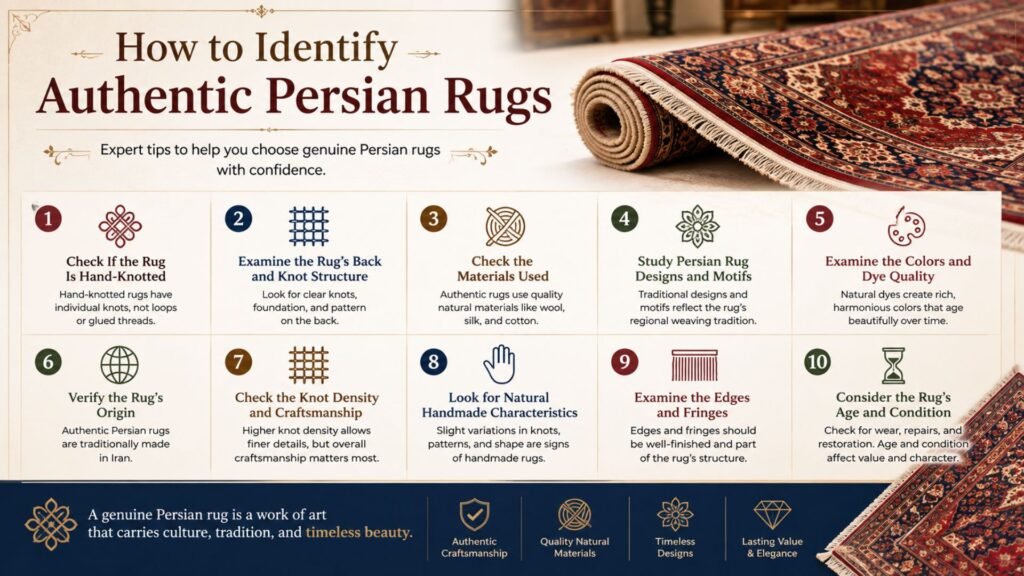
Authentic Persian rugs are valued for their traditional craftsmanship, distinctive designs, quality materials, and detailed hand-knotted construction. To identify an authentic Persian rug, look beyond its appearance and examine its knotting technique, materials, design, colors, origin, craftsmanship, and overall condition. In this guide, Safa Carpet Gallery explains the key characteristics to look for when evaluating genuine Persian rugs, including how to distinguish handmade Persian rugs from machine-made and Persian-style carpets. Whether you are a first-time buyer or a collector of fine Persian carpets, these practical steps can help you make a more informed decision when choosing an authentic piece.
An authentic Persian rug is more than a carpet with a traditional Persian pattern. Its authenticity is reflected in its origin, craftsmanship, materials, knotting technique, design, and overall construction. Traditional Persian rugs are known for their detailed workmanship and regional weaving traditions, with many fine pieces made by hand over an extended period.
When evaluating a Persian rug, it is important to consider several characteristics together rather than relying on one feature alone. A hand-knotted Persian rug may show individual knots on the back, natural variations from handmade production, carefully crafted motifs, and materials such as wool, silk, or cotton. The rug’s origin and construction should also be considered when determining whether it is a genuine Persian carpet.
If you want to understand the craftsmanship behind hand-knotted Persian rugs, read our guide to What Are Hand Knotted Persian Rugs?
Identifying authentic Persian rugs requires looking beyond the design and overall appearance. While many modern carpets can feature traditional Persian-inspired patterns, genuine Persian rugs are distinguished by their craftsmanship, construction, materials, origin, and weaving traditions. By carefully examining these characteristics, you can better understand whether a rug is an authentic handmade piece or a Persian-style carpet.
One of the first things to examine is how the rug was constructed. The knotting technique can reveal important information about the craftsmanship and help distinguish hand-knotted Persian rugs from machine-made carpets.
One of the easiest ways to identify hand-knotted Persian rugs is to examine the back of the rug. You should be able to see individual knots forming the pattern. Hand-knotted carpets may also have slight natural variations because they are made by skilled artisans rather than machines. These characteristics are common in handmade Persian rugs and can help distinguish them from machine-made carpets.
Turn the rug over and examine the knots and foundation. Hand-knotted Persian carpets usually show individual knots on the back, which can help reveal their handmade construction. Knot structure should be considered along with other authenticity factors.
Traditional Persian wool rugs, handmade wool rugs, and silk Persian rugs are commonly made from natural materials. Check the material quality and consider it together with the rug’s construction and origin.
Traditional Persian rugs feature distinctive floral, geometric, medallion, and border patterns. Studying Persian rug designs and Persian carpet patterns can help identify their regional style and weaving tradition.
Traditional Persian rug colors often include rich reds, blues, ivory, and earthy shades. Examine how the colors are balanced and distributed, but remember that color alone cannot prove authenticity.
Ask where the rug was made and, when possible, its specific region. Persian rugs from Iran reflect Persian weaving traditions. If buying Persian rugs in Thailand, always verify the actual country of manufacture.
Persian rug knot density can indicate the level of detail in a rug. However, higher knot density does not automatically mean better quality. Consider the craftsmanship, materials, design, and construction together.
Handmade Persian rugs may have small variations in knots, patterns, edges, or shape. These natural differences can be signs of traditional handmade craftsmanship rather than defects.
Check the edges and fringes as part of the rug’s overall construction. Authentic Persian rugs may show handmade characteristics, but fringe alone should never be used to determine authenticity.
For antique Persian carpets, vintage Persian rugs, and fine Persian rugs, check their age, wear, repairs, and restoration history. Condition can significantly affect the rug’s character and value.
To understand the differences between handmade and machine-produced carpets, see our guide to Hand Knotted vs Machine Made Rugs.
An authentic Persian rug is traditionally made in Iran and reflects Persian weaving traditions and craftsmanship. A Persian-style rug may be made in another country but use similar Persian-inspired designs, colors, or motifs.
When buying genuine Persian rugs, always check the rug’s origin, construction, materials, design, and craftsmanship rather than judging authenticity by appearance alone.
A handmade Persian rug is typically created by skilled artisans using traditional weaving techniques. Look for visible individual knots, slight natural variations, and a detailed construction on the back of the rug.
Hand-knotted Persian rugs often show these handmade characteristics, unlike machine-made carpets with highly uniform construction. Always consider the rug’s knotting, materials, design, and origin together when evaluating its authenticity.
Before buying authentic Persian rugs, ask about the rug’s origin, materials, knotting technique, age, condition, and craftsmanship. If possible, also ask whether the rug has been repaired or restored.
These details can help you make a more informed decision when choosing genuine Persian rugs for your home or collection.
Handmade Persian rugs combine traditional craftsmanship, distinctive designs, and quality materials. Each hand-knotted carpet is carefully created by skilled artisans, giving it unique character and detail.
For homeowners looking for fine Persian rugs that add warmth, elegance, and timeless style to an interior, a handmade Persian rug can be a beautiful long-term choice.
How can you tell if a Persian rug is authentic?
Check its origin, knotting technique, materials, design, craftsmanship, and overall condition.
Are all Persian rugs hand-knotted?
No. Persian rugs can have different construction methods, so always check how the rug was made.
How can you tell if a Persian rug is handmade?
Examine the back for individual knots and look for natural variations in the pattern, edges, and shape.
What makes Persian rugs valuable?
Craftsmanship, materials, design, age, condition, rarity, and origin can all contribute to a rug’s value.
Are authentic Persian rugs made in Iran?
Traditional Persian rugs are associated with Iran and its regional weaving traditions. Always verify the rug’s actual origin.
What is the difference between a Persian rug and a Persian-style rug?
An authentic Persian rug traditionally originates from Iran, while a Persian-style rug may be produced elsewhere using Persian-inspired designs.
Discover a curated selection of authentic Persian rugs, handmade Persian carpets, and hand-knotted rugs at Safa Carpet Gallery. Explore traditional craftsmanship, distinctive designs, and fine-quality carpets for your home.