
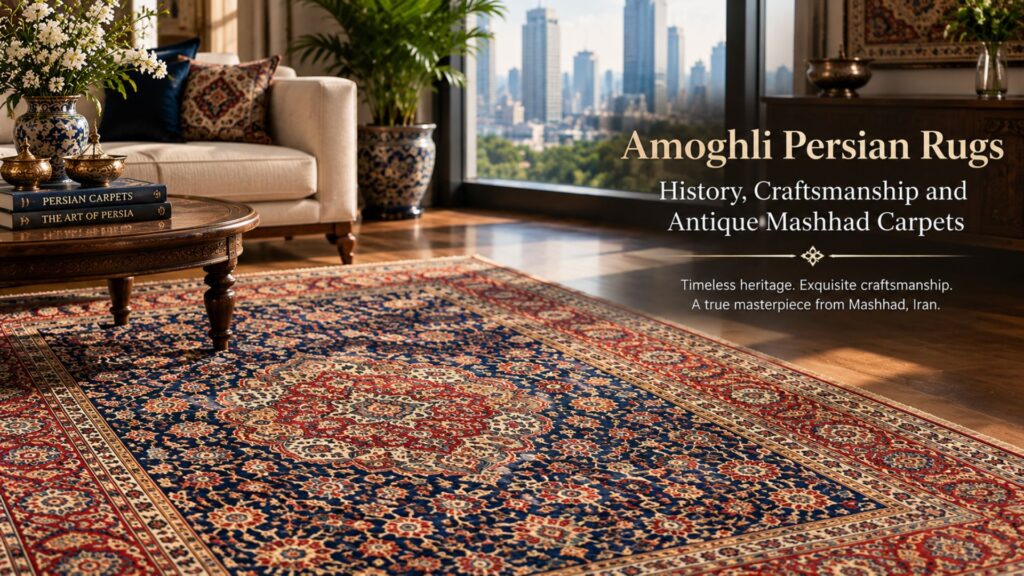
Persian rugs are admired around the world for their detailed patterns, rich colours and remarkable craftsmanship. Among the most distinguished names in Persian carpet weaving is Amoghli, a name associated with fine handmade carpets from Mashhad, Iran. These rugs are especially interesting to collectors and homeowners who appreciate traditional design, skilled weaving and the character of antique Persian carpets.
For homeowners in Thailand, an Amoghli rug can bring warmth, history and artistic detail into a space. Whether you are furnishing a Bangkok condominium, decorating a luxury residence or choosing a statement piece for a hotel or private collection, understanding the origins and craftsmanship of Amoghli Persian rugs can help you make a more informed decision.
In this guide, we explore the history of Amoghli carpets, their defining characteristics, how to assess authenticity and what to consider when choosing a Persian rug for a Thai interior.
Amoghli Persian rugs are associated with the renowned carpet-weaving tradition of Mashhad, a city in northeastern Iran. The Amoghli name is particularly connected with finely woven carpets produced during the late nineteenth and early twentieth centuries, when Mashhad became known for important workshops and master weavers.
The work associated with the Amoghli brothers, including Abdol Mohammad and Ali Khan Amoghli, is admired for its attention to detail, intricate patterns and refined execution. Historical accounts also connect some of these carpets with royal and distinguished commissions.
Unlike machine-made floor coverings, traditional hand-knotted rugs are created by tying individual knots around the foundation of the carpet. The process takes considerable time and skill, particularly when the design includes small floral details, elaborate borders and complex central compositions.
Mashhad has a long-standing reputation as an important centre of Persian carpet production. During the late nineteenth and early twentieth centuries, workshops in the city created carpets for domestic use, collectors and prestigious commissions.
The Amoghli workshop became one of the best-known names associated with this tradition. Its reputation grew through the production of carefully designed carpets featuring fine weaving, detailed ornamentation and rich colour combinations. Some historical accounts connect Amoghli carpets with the Iranian royal court and palace interiors.
The name is important to collectors because it refers to a particular workshop tradition rather than simply a general Persian rug design. However, a carpet should not be attributed to Amoghli solely because it looks similar to a known example. Its construction, inscriptions, condition and documented history all deserve careful examination.
Antique Amoghli carpets are therefore valued not only for their appearance but also for the craftsmanship and historical context that may be associated with an individual piece.
Several qualities help explain why Amoghli carpets attract the attention of Persian rug enthusiasts.
Fine hand-knotted Persian rugs require patience and technical skill. Each knot contributes to the design, texture and overall structure of the carpet. In a finely woven piece, the maker can create delicate curves, small floral elements and carefully balanced patterns.
Knot density is one useful detail to examine, but a higher knot count does not automatically mean that a rug is better. The quality of the wool, consistency of the weave, clarity of the design and condition of the carpet are also important.
Amoghli-associated carpets can feature elaborate floral compositions, central medallions, decorative corner pieces and multiple borders. These elements create a sense of structure while allowing detailed patterns to fill the field of the rug.
Some designs are visually rich and formal, making them suitable for traditional interiors. Others can work as striking contrasts in contemporary spaces when the surrounding furniture and colours are kept relatively simple.
Deep reds, blues, ivory tones and other traditional Persian colours appear in many Mashhad carpets. The precise palette varies from one rug to another, depending on its materials, dyes, age and design.
When evaluating an antique rug, look at how the colours work together rather than judging the piece by one shade alone. Natural ageing, wear and changes in dye can also influence the way an older carpet appears today.
Wool is an important material in Persian carpet making, while silk and cotton may also be used depending on the piece. The materials should be assessed on the actual rug rather than assumed from its name or appearance.
The foundation, pile, knot structure and finishing details can provide useful information about how a carpet was made. These details are particularly important when comparing an antique piece with a more recent handmade rug.
If you are considering an antique Amoghli Persian rug, take time to evaluate its history and construction. A beautiful pattern alone cannot confirm the maker.
Some rugs attributed to Amoghli have woven inscriptions or signatures. These can be useful clues, but the presence of a name is not conclusive proof of authenticity. The inscription, lettering, placement and weaving should be examined alongside the rest of the carpet.
The back of a hand-knotted Persian carpet often reveals its knot structure and how clearly the pattern has been formed. Examine the consistency of the weave, the foundation and the finishing along the edges.
A rug specialist can help assess whether the construction is consistent with the claimed origin and period.
Inspect the pile for wear, thinning, repairs and uneven areas. Check the fringes and sides for signs of replacement or restoration. Repairs are not necessarily a reason to reject an antique rug, but their quality and extent can affect its appearance and value.
Materials should be evaluated carefully, particularly if the seller claims that a carpet contains a specific type of wool or silk.
Provenance refers to the available history of a rug, including previous ownership, records, documentation and any credible information about its origin. For a high-value antique, supporting documentation and a specialist assessment can be especially useful.
For more guidance, read our guide to identifying authentic Persian rugs. It explains how construction, materials and craftsmanship can help buyers evaluate Persian carpets.
Antique Amoghli rugs can attract collector interest because of their historical associations, fine craftsmanship and relative rarity. However, not every carpet attributed to Amoghli has the same value.
Important factors include:
A rug’s age or intricate appearance alone does not establish its market value. If you are purchasing an antique Amoghli carpet as a collectible, seek a transparent description and an independent expert opinion when appropriate.
It is also worth remembering that buying a rug for your home and buying one primarily as a collectible are different decisions. Consider both the artistic qualities you enjoy and the practical requirements of the space where it will be used.
Thailand has a wide range of interior styles, from contemporary Bangkok condominiums to traditional Thai-inspired residences and spacious luxury homes. A carefully chosen Persian rug can complement these spaces without overwhelming them.
In a modern condominium, an Amoghli rug can introduce texture and character into a relatively simple room. Consider the size of the seating area, the colour of the flooring and the amount of natural light.
A richly patterned rug can become the centrepiece of a neutral living room. Alternatively, a softer colour palette may work better when the room already contains bold furniture or decorative accents.
In a larger living room, a generously sized Persian carpet can help connect the sofa, chairs and coffee table into one coherent arrangement. Traditional medallion designs can work particularly well in rooms with wood furniture, classic detailing or carefully selected artwork.
Choose a size that allows the rug to relate naturally to the furniture rather than appearing like a small island in the middle of the room.
Persian carpets can complement Thai interiors when their colours and patterns are balanced with natural materials, wood, stone, linen and restrained decorative details.
For a harmonious look, pick one or two colours from the rug and repeat them in cushions, artwork or other accessories. This makes the rug feel integrated into the room rather than added as an afterthought.
A distinctive handmade Persian rug can add personality to a private office, reception area or selected hospitality space. Before choosing an antique, consider foot traffic, cleaning requirements and whether the rug will be exposed to direct sunlight.
For heavily used areas, the suitability of the particular rug matters more than its appearance alone.
Thailand’s warm, humid climate makes thoughtful rug care especially important. Wool and other natural fibres can last for many years when properly maintained, but moisture and unsuitable cleaning methods can cause problems.
Follow these practical guidelines:
For more detailed advice, visit our Persian rug care guide.
Choosing a fine Persian carpet involves more than finding an attractive pattern. Understanding its origin, materials, craftsmanship and condition helps you decide whether it is right for your home or collection.
Safa Carpet Gallery offers a selection of Persian carpets and presents Amoghli among the notable names associated with Persian carpet craftsmanship. Based in Bangkok, the gallery serves customers interested in authentic Persian carpets, antique pieces and handmade rugs.
If you are researching Persian rugs in Bangkok or exploring Persian rugs in Thailand, start by comparing the rug’s dimensions, colours, construction and condition with the needs of your space.
Explore the Amoghli Persian carpet collection at Safa Carpet Gallery to view the existing collection page and learn more about this distinctive weaving tradition.
Amoghli carpets are associated with Mashhad, a major carpet-producing city in northeastern Iran. The Amoghli workshop became known for finely crafted Persian carpets, particularly during the late nineteenth and early twentieth centuries.
Amoghli refers to a specific workshop name and tradition associated with Mashhad. Mashhad rugs more broadly include carpets from many makers and workshops, so not every Mashhad rug should be described as an Amoghli.
No. The name is associated particularly with historical carpets, but a rug’s age and attribution must be assessed individually. Ask for supporting details rather than assuming that every rug carrying the name is an antique.
Consider the signature, weaving structure, materials, condition and provenance together. Visual resemblance alone is not enough to establish authenticity. For a valuable antique, seek an experienced Persian rug specialist.
They can be. A well-proportioned rug can bring colour, texture and artistic detail to a modern condominium or luxury home. Choose the dimensions and colour palette to suit your furniture, flooring and overall interior style.
Keep it dry, limit prolonged direct sunlight, maintain good ventilation and vacuum gently. For stains, deep cleaning or restoration, consult a specialist familiar with antique hand-knotted rugs.
Amoghli Persian rugs represent an important chapter in the history of Mashhad carpet weaving. Their appeal lies in the combination of detailed craftsmanship, intricate designs and historical associations that make individual pieces worth examining closely.
For collectors and homeowners in Thailand, the right Amoghli carpet can become a meaningful part of a room’s design. Take time to assess authenticity, materials, condition and size, and choose a piece that suits both your interior and your expectations.
At Safa Carpet Gallery, exploring the Amoghli collection is a starting point for learning more about this distinctive Persian carpet tradition and finding a rug that complements your space.