
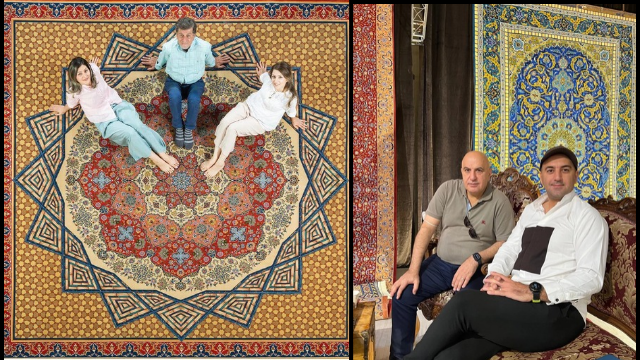
A beautiful Persian rug can change the character of a room. It brings warmth to a space, adds depth through its colours and patterns, and introduces a sense of craftsmanship that is difficult to achieve with ordinary floor coverings.
Among the respected names associated with fine Persian carpet weaving, the Haghighi Family holds a special place. Known for its artistic heritage in Isfahan, Iran, the family has contributed to the tradition of creating handmade carpets that combine detailed weaving with expressive Persian designs.
For homeowners, interior designers and collectors in Thailand, understanding the history behind Haghighi Family Persian Rugs offers a different perspective on choosing a carpet. Rather than looking only at colour or size, it becomes possible to appreciate the people, techniques and artistic decisions behind each piece.
At Safa Carpet Gallery in Bangkok, we believe that learning about traditional Persian carpet makers is an important part of appreciating authentic handmade rugs.
The Haghighi Family is associated with the historic carpet-weaving city of Isfahan, one of Iran’s most important centres of Persian art and craftsmanship.
The family’s weaving heritage developed across generations, with different members contributing their own skills in design, weaving and artistic interpretation.
Isfahan has a long history of decorative arts, architecture, textiles and fine carpet weaving. Its artistic traditions have influenced some of the most recognisable styles of Persian rugs.
The Haghighi family’s heritage can be traced through earlier generations of craftsmen, including Abdolsamad Khan and Abdolmotaleb Khan, whose approaches to weaving helped shape the family’s artistic direction.
Over time, the family became associated with carpets that reflected both established Persian design traditions and individual artistic expression.
Mehdi Khan Safdarzadeh Haghighi (1888–1968) was an important figure in the family’s history.
Growing up in Isfahan, he was surrounded by traditional craftsmanship and developed an interest in combining intricate weaving with artistic design.
His association with Persian artist and designer Mirza Agha Emami contributed to a distinctive approach to carpet composition.
This relationship between weaving and visual art remains an important part of the Haghighi story.
Fine Persian carpets are valued for more than their appearance. The weaving method, materials, design and finishing all contribute to the character of the finished piece.
Haghighi Family carpets are particularly associated with an artistic approach to traditional Persian rug making.
Hand-knotting is a labour-intensive process in which skilled weavers create individual knots around the foundation threads of a carpet.
The design gradually takes shape as rows of knots are completed.
Depending on the size, complexity and weaving technique, producing a fine handmade carpet may require considerable time and careful coordination.
Unlike machine-produced rugs, a hand-knotted carpet carries subtle variations that reflect the process of its creation.
For readers who would like to understand this technique in greater detail, our guide to Hand-Knotted Persian Rugs explains how traditional weaving differs from modern manufacturing.
Traditional fine Persian rugs may use wool, silk, cotton or combinations of these materials.
Wool is appreciated for its resilience and texture, while silk can introduce delicate highlights and allow intricate details to stand out.
Knot density is another important consideration, particularly in carpets with highly detailed designs. However, a higher knot count does not automatically make one rug better than another.
The quality of the fibres, the skill of the weavers, the overall composition and the condition of the carpet should all be considered together.
Each Haghighi carpet should therefore be examined individually rather than judged solely by the reputation of its maker.
One of the most interesting aspects of traditional Persian rugs is the relationship between carpet weaving and other forms of Persian art.
In Isfahan, carpet patterns have long been influenced by architecture, decorative painting, gardens and classical ornamentation.
Traditional Isfahan carpets often feature carefully balanced arrangements of floral motifs, scrolling vines, central medallions and decorative borders.
These patterns can create a sense of movement while maintaining visual harmony.
In a large living room, a detailed Persian rug can become the centre of the interior. In a smaller space, a thoughtfully chosen pattern can introduce interest without overwhelming the furniture.
When considering a Haghighi Family carpet, it is worth looking closely at how the different elements of the design work together.
The Haghighi tradition includes examples of carpets that go beyond conventional repeating patterns.
Some works draw inspiration from architectural forms, historical themes and pictorial storytelling.
This approach reflects a broader idea within Persian carpet making: a carpet can serve as both a practical textile and a work of art.
For collectors, these artistic qualities may be just as important as the rug’s materials or dimensions.
The history of the Haghighi Family is not limited to one individual. Its artistic development reflects the contributions of several generations.
Mehdi Khan helped establish the family’s distinctive approach to carpet artistry.
His son, Feizollah Khan Safdarzadeh Haghighi (1942–2020), continued the tradition while introducing his own artistic perspective.
Feizollah studied fine arts in Isfahan and developed an interest in combining traditional Persian motifs with architectural and cultural influences.
His work helped carry the family’s craftsmanship into a new generation.
Later generations continued exploring the relationship between traditional weaving and contemporary artistic ideas.
Mohammad Mehdi Haghighi, with a background in architecture, developed carpet compositions influenced by geometry, storytelling and design.
Alireza Haghighi has also contributed to the family’s artistic direction, combining knowledge of traditional carpet making with modern design techniques.
Together, these generations demonstrate how a historic weaving tradition can evolve while maintaining its cultural identity.
When purchasing a fine Persian carpet, authenticity deserves careful attention.
A well-known family name can add interest to a rug, but the name alone should never be treated as proof of origin or authorship.
Start by examining the back of the carpet.
In a traditional hand-knotted rug, the pattern is generally visible on the reverse, where the individual knots and foundation structure can be inspected.
The materials should also be considered. Look at the texture of the pile, the foundation, the quality of the finishing and the consistency of the weaving.
Some workshop carpets may include woven signatures or inscriptions. However, a signature by itself is not sufficient evidence that a particular family member designed or supervised the carpet.
For a collectible Haghighi rug, provenance is especially important.
Useful documentation may include information about the workshop, designer, weaving period, previous ownership and any restoration.
Buyers should also examine the carpet’s condition, including the edges, fringes, pile wear and any repaired areas.
If you are new to Persian carpets, read our Guide to Identifying Authentic Persian Rugs before making a purchase.
A fine Persian rug can work beautifully in both traditional and contemporary interiors.
In Thailand, where modern condominiums, spacious family homes and luxury residences often feature natural materials and open living areas, Persian rugs can provide a welcome contrast.
Many Bangkok condominiums use neutral colours, polished floors and simple furniture.
A Persian rug can soften these interiors while introducing a richer colour palette.
For example, a carpet with ivory, blue or warm red details can complement cream upholstery, dark wood and contemporary lighting.
In a compact living room, the rug should be proportionate to the seating arrangement.
Ideally, it should help connect the sofa, chairs and coffee table into one comfortable space.
Before selecting a Persian carpet, measure the room and consider how the furniture will sit around it.
For a living room, a rug that extends beneath the front legs of the main seating pieces often creates a more balanced arrangement.
In a dining room, the carpet should be large enough to accommodate chairs when they are pulled back from the table.
Colour is equally important.
Warm-toned Persian carpets can work well with teak furniture and natural finishes, while blue and ivory designs may complement lighter, contemporary interiors.
The right choice is not necessarily the most elaborate rug. It is the one that feels appropriate for the room and the people who use it.
Thailand’s warm and humid climate makes proper carpet care particularly important.
Natural fibres can be affected by prolonged moisture, poor ventilation and inappropriate cleaning methods.
Regular, gentle vacuuming helps remove dust and surface dirt before it becomes embedded in the pile.
Avoid aggressive brushing or unnecessary friction, especially on delicate silk or finely woven carpets.
Rotate the rug periodically if one section receives more sunlight or foot traffic than another.
Good airflow is important in rooms where handmade carpets are displayed.
Avoid placing a rug directly onto a persistently damp floor or storing it in a poorly ventilated area.
If a carpet becomes wet, professional attention may be necessary to prevent further damage.
For additional advice, explore our Persian Rug Care Tips, including practical considerations for maintaining handmade carpets in Thailand.
Choosing a Persian rug is often easier when you can examine its details in person.
Photographs may show the overall design, but they cannot always communicate the texture of the fibres, the fineness of the weaving or the way colours change under different lighting.
At Safa Carpet Gallery, we encourage customers to learn about Persian carpet craftsmanship and explore styles that suit their homes.
Our Haghighi Family Persian Rugs Collection introduces this important name in Iranian carpet weaving.
Whether you are decorating a Bangkok condominium, furnishing a family home or developing an interest in collectible Persian carpets, understanding the maker’s history can make the selection process more meaningful.
For anyone comparing distinguished Isfahan weaving traditions, our Seirafian Family Collection provides another perspective on fine Persian carpet craftsmanship.
Please contact the gallery to confirm the availability and provenance of individual pieces.
The Haghighi Family is historically associated with Isfahan, Iran, a city celebrated for its fine Persian carpets and traditional decorative arts.
The family’s traditional carpet-making heritage centres on handmade weaving. However, buyers should verify the construction and provenance of any individual carpet offered under the Haghighi name.
Factors may include craftsmanship, materials, design complexity, age, condition, provenance and documented connections to particular designers or workshops.
Yes. Depending on their size, colour and design, traditional Persian carpets can complement modern condominiums, contemporary houses and classical interiors throughout Bangkok and Thailand.
Examine the weaving, materials, condition and documentation. For an important collectible piece, request reliable provenance and consider an independent specialist assessment.
The Haghighi Family represents an important chapter in the continuing story of Persian carpet weaving.
From its roots in Isfahan to the contributions of later generations, the family’s work demonstrates how traditional craftsmanship and artistic imagination can exist together.
For homeowners and collectors in Thailand, Haghighi Persian rugs offer an opportunity to appreciate the cultural history behind handmade carpets.
At Safa Carpet Gallery, we believe that choosing a Persian rug should be about more than filling an empty floor. It should be about finding a piece whose craftsmanship, design and character belong naturally in your home.
Explore the Haghighi Family collection and discover the enduring appeal of fine Persian carpet artistry.