
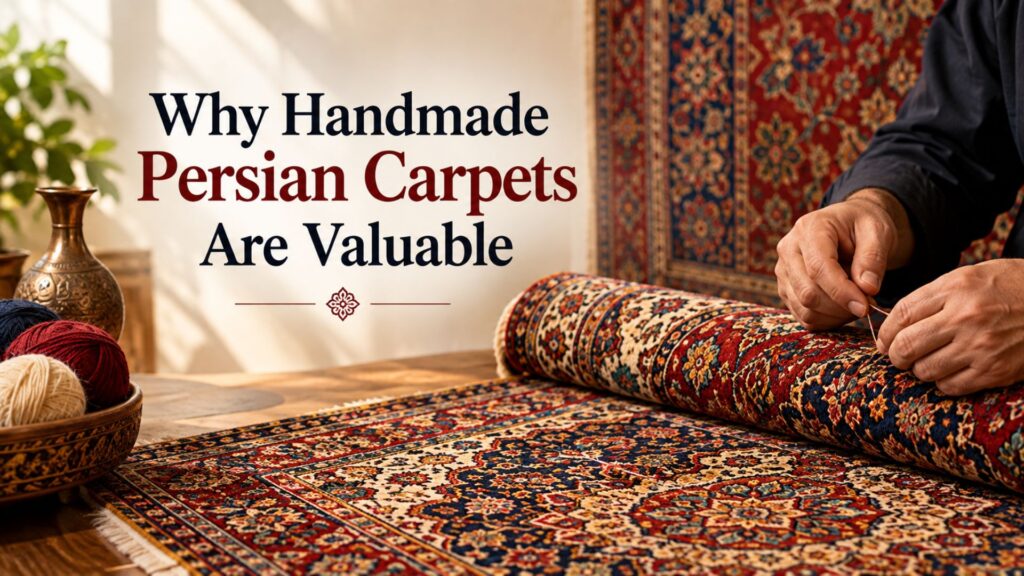
A handmade Persian carpet is more than something you place on the floor. When you look closely at one, you can see the time, patience, and skill that went into making it. The patterns are carefully created, the materials are selected with purpose, and every knot is part of the finished design.
This is one of the main reasons handmade Persian carpets continue to be appreciated by homeowners, collectors, and interior designers.
Unlike factory-made carpets, a handmade Persian carpet is created by skilled artisans using traditional techniques. The small variations that appear in the design or construction can actually be part of what makes each carpet special.
But what really determines the value of a handmade Persian carpet? It comes down to several things, including craftsmanship, materials, design, origin, age, condition, and authenticity.
There isn’t one single reason why a Persian carpet is valuable. Its value comes from the combination of many details.
A well-made carpet may have excellent craftsmanship, quality wool or silk, a distinctive design, a respected weaving tradition, and good overall condition.
This is why two carpets that look similar at first glance can have very different values.
The first thing that sets handmade Persian carpets apart is the work involved in making them.
A hand-knotted carpet is produced knot by knot on a loom. The weaver follows the design while gradually building the pattern and structure of the carpet.
This is slow, detailed work. It requires experience and a good understanding of traditional weaving techniques.
The result is a carpet with a character that is difficult to reproduce through mass production.
For buyers, this craftsmanship is one of the most important things to understand when comparing a handmade carpet with a machine-made alternative.
Hand-knotted Persian rugs are particularly appreciated because each knot is tied by hand.
The construction can be examined from the back of the rug, where the individual knots and foundation become easier to see. The quality of the knotting, consistency of the construction, and level of detail can all tell you something about the workmanship.
However, knot count should not be considered on its own.
A beautiful and valuable Persian rug is the result of the overall combination of construction, materials, design, origin, condition, and craftsmanship.
You can learn more about this in our guide to What Are Hand Knotted Persian Rugs?.
Materials have a major influence on the look and feel of a carpet.
Traditional handmade Persian carpets can be made using wool, silk, cotton foundations, or combinations of these materials.
Wool is widely appreciated for its durability and natural texture. Silk can create a finer surface and allow highly detailed patterns and subtle visual effects.
Some Persian carpets also combine different materials to achieve a particular texture, structure, or appearance.
When buying a handmade carpet, it is therefore useful to ask:
Understanding the material helps you appreciate why one carpet may be valued differently from another.
The design is another important part of a Persian carpet’s appeal.
Traditional Persian carpets can feature floral patterns, medallions, geometric forms, gardens, hunting scenes, pictorial compositions, and many other artistic themes.
These designs are not simply decorative. They reflect different weaving traditions and artistic influences.
Some carpets have relatively simple compositions, while others contain incredibly detailed patterns that require considerable skill to produce.
This is particularly noticeable in Persian pictorial rugs, where the carpet itself can function almost like a textile artwork.
For buyers who appreciate artistic carpets, the design can be just as important as the construction.
The place where a carpet was made can also influence its character and value.
Persian carpet-making has developed across many regions, and different areas became known for particular designs, materials, colors, and weaving traditions.
For this reason, experienced buyers often pay attention to the carpet’s origin rather than simply looking at its overall appearance.
A carpet associated with a particular weaving centre, workshop, family, or master weaver may have characteristics that help distinguish it from other Persian carpets.
This is also why understanding provenance can be useful when purchasing authentic Persian rugs.
Age can add another dimension to a Persian carpet.
Antique Persian carpets can carry a sense of history that is difficult to reproduce in a new carpet. Their colors, patterns, construction, and signs of age can tell something about their journey over the years.
But an old carpet isn’t automatically valuable simply because it is old.
Its condition matters.
A buyer should consider:
A well-preserved antique carpet with excellent craftsmanship may be much more desirable than an older carpet that has suffered extensive damage.
One of the nicest things about handmade Persian rugs is that no two pieces are necessarily exactly the same.
Handmade production naturally creates small differences. A pattern may have slight variations, the shape may not be perfectly uniform, or the colors may show subtle changes.
These characteristics are part of the handmade nature of the carpet.
For many collectors and homeowners, this individuality is exactly what makes handmade rugs attractive.
Instead of buying something produced thousands of times in exactly the same way, you are choosing a piece with its own character.
When purchasing an expensive Persian carpet, appearance alone is not enough.
A carpet may look traditional but still require careful examination before you decide what it is worth.
Look at:
Our guide on How to Identify Authentic Persian Rugs explains these points in more detail.
Taking the time to understand authenticity can help you make a much more informed purchase.
The difference between handmade and machine-made carpets becomes easier to understand when you look at how they are produced.
A handmade carpet is created by artisans, while a machine-made carpet is produced through industrial manufacturing.
Machine-made carpets can be practical and affordable, but they don’t offer the same type of individual craftsmanship found in a traditional handmade carpet.
If you are choosing between the two, think about what matters most to you:
For a detailed comparison, read Hand Knotted vs Machine Made Rugs.
If you are buying a handmade Persian carpet, don’t focus on just one feature.
Instead, look at the carpet as a whole.
Look closely at the knots, edges, pile, and overall construction.
Understand whether the carpet is made from wool, silk, cotton, or a combination of materials.
Consider whether the pattern is traditional, pictorial, geometric, floral, or another style.
Knowing where a carpet was made can provide useful context about its design and construction.
Look for wear, repairs, restoration, fading, and structural issues.
If a carpet is described as antique, ask what information supports its age.
When available, certificates or other documentation can provide additional information about the carpet.
A good handmade Persian carpet can stay in a home for many years.
It can become part of a room, a family’s story, and eventually something that is passed from one generation to another.
This long-term relationship is one reason people appreciate fine Persian rugs differently from ordinary home furnishings.
A carpet that is carefully selected and properly maintained can continue to be enjoyed even as interior styles change.
Good care is important if you want your handmade Persian carpet to maintain its appearance and condition.
Simple habits can make a difference:
For more information, read our How to Clean Persian Rugs: A Complete Care & Cleaning Guide.
The right carpet isn’t necessarily the most expensive one.
It should be the carpet that fits your space, lifestyle, design preferences, and expectations.
Before buying, think about:
Size: Will the carpet fit comfortably in the room?
Design: Does the pattern work with your furniture and interior?
Material: Is wool or silk more suitable for your needs?
Construction: Is the carpet hand-knotted or handwoven?
Condition: Is the carpet suitable for everyday use or better suited to a collection?
Character: Do you genuinely like the carpet rather than buying it only because someone says it is valuable?
These questions can make the buying process much easier.
At Safa Carpet Gallery, the collection focuses on authentic Persian rugs, hand-knotted carpets, handmade luxury carpets, and antique pieces created through traditional craftsmanship.
The collection includes carpets made from wool and silk, along with different Persian designs, weaving traditions, sizes, and styles.
You can explore the Hand Knotted Carpet collection to see different types of handmade Persian carpets.
You can also explore the Pictorial collection for carpets featuring detailed artistic compositions.
For more information about the gallery and its collections, visit the Safa Carpet Gallery homepage.
Handmade Persian carpets are valuable because they combine skilled craftsmanship, quality materials, traditional designs, individual character, and Persian weaving heritage.
They are made differently. Handmade Persian carpets offer individual craftsmanship and traditional construction, while machine-made carpets are produced through industrial manufacturing and can be more affordable.
Craftsmanship, material, design, origin, age, condition, rarity, authenticity, and maker can all influence the value.
No. Age is only one factor. Condition, craftsmanship, design, origin, materials, and authenticity also need to be considered.
Start by examining the knot structure, back, materials, design, edges, and overall construction. Origin and documentation can also provide useful information.
The real appeal of handmade Persian carpets is the combination of craftsmanship and character.
Every carpet has its own story from the hands that created it to the materials, patterns, and traditions behind its design.
That is what makes a handmade Persian carpet different from an ordinary mass-produced carpet.
Whether you are looking for a handmade Persian rug for your home, a fine carpet for an interior project, or an antique piece for a collection, understanding craftsmanship, materials, origin, condition, and authenticity will help you make a more confident choice.