
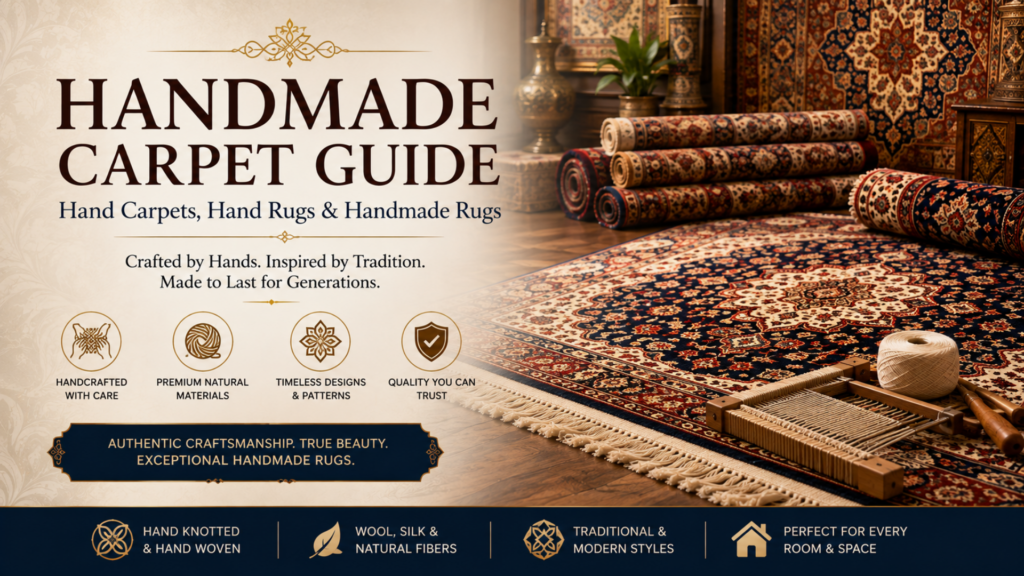
A handmade carpet is more than a decorative floor covering. It represents the time, skill, materials, and craftsmanship involved in creating a rug by hand. Unlike mass-produced carpets, handmade rugs can have subtle variations that give each piece its own character.
For homeowners, collectors, and interior designers, understanding the difference between hand carpets, handmade carpets, hand rugs, and machine-made alternatives can make choosing the right rug much easier.
At Safa Carpet Gallery, our collection focuses on authentic Persian carpets and rugs, including hand-knotted pieces created through traditional craftsmanship. The gallery has been established since 1922 and brings generations of Persian carpet experience to its collection.
A handmade carpet is produced using manual craftsmanship rather than being manufactured entirely by automated machines.
Depending on the construction, artisans may use techniques such as hand-knotting, hand-weaving, or other traditional methods. The construction method affects the rug’s texture, appearance, durability, production time, and overall character.
Handmade carpets can be created in many styles, from traditional patterns to contemporary designs.
The important point is that “handmade” describes the way the carpet is produced. It does not automatically mean that every handmade carpet is Persian or hand-knotted.
The term hand carpet is commonly used to describe a carpet made through manual craftsmanship.
A hand carpet may be produced using different techniques, so buyers should look beyond the name and ask how the carpet was actually constructed.
Important questions include:
Understanding these details gives you a better idea of what you are actually buying.
Hand rugs are rugs made using manual techniques rather than being completely machine-produced.
They can include hand-knotted rugs, hand-woven rugs, and other artisan-made constructions.
Because the term can cover different techniques, “hand rug” should not be treated as a specific construction method. The weaving or knotting technique should always be checked separately.
For valuable Persian rugs, construction, origin, material, design, and craftsmanship should be considered together.
One of the most important decisions when buying a rug is understanding how it was produced.
Handmade carpets are produced through manual craftsmanship. Depending on the technique, artisans may spend considerable time creating the structure and design.
They can offer:
Machine-made carpets are produced using automated manufacturing systems.
They can provide:
Neither category is automatically suitable for every situation. The best choice depends on your intended use, design preference, material, budget, and expectations for craftsmanship.
For a detailed comparison, see Safa Carpet Gallery’s guide to Hand Knotted vs Machine Made Rugs.
Not every handmade rug is constructed in exactly the same way.
Hand-knotted rugs are created by tying individual knots around the foundation of the rug.
This technique requires significant manual work and can produce highly detailed patterns.
The knot structure can also be examined from the back of the rug when evaluating how it was made.
Safa Carpet Gallery specializes in hand-knotted Persian carpets and rugs, with collections including Pictorial, Poshti, Zarcharack, Zaronim, Ghaliche, Pardeh, Kalegi, Ghali, Kenare, Gabeh, and Gelim.
Hand-woven rugs are also made manually, but the construction method differs from individual knotting.
The distinction is important because hand-knotted and hand-woven rugs can have different textures, structures, production processes, and characteristics.
The term “handmade” therefore should not be used as a substitute for knowing the exact construction technique.
Materials have a major influence on the appearance, texture, durability, and feel of a handmade carpet.
Wool is widely used in handmade rugs because of its natural characteristics and durability.
A well-made wool rug can work well in many residential interiors when properly maintained.
Silk can provide a refined appearance, detailed designs, and a distinctive surface texture.
Because silk is more delicate than many wool constructions, silk rugs require careful handling and appropriate maintenance.
Some fine Persian carpets combine wool and silk to achieve particular visual and structural characteristics.
The exact material composition should always be checked before purchasing a rug.
Safa Carpet Gallery’s current collection includes examples using materials such as wool on cotton, wool on silk, and silk on silk.
The appeal of handmade rugs is not simply that they are made without machines.
Their character comes from the combination of craftsmanship, materials, design, and construction.
Small variations in handmade rugs can occur because they are created by people rather than automated production systems.
These variations can contribute to the character of an individual piece.
Complex designs require careful attention to pattern, color, knotting, and finishing.
Many handmade carpets continue techniques that have been passed from one generation of artisans to another.
Two rugs with similar designs may still have differences in texture, color, construction, and appearance.
That individuality is part of the appeal of handmade rugs.
Handmade does not mean that a rug must have an antique or traditional appearance.
Handmade rugs can include both traditional and contemporary designs.
Traditional rugs may feature:
Modern handmade rugs can use:
The competitor material also highlights this distinction, with modern handmade carpets designed for contemporary interiors alongside traditional rugs.
For buyers, the important question is not whether a rug is modern or traditional, but whether its design, construction, size, and material suit the intended space.
Choosing a handmade rug should begin with the room rather than the rug alone.
Measure the available floor area before choosing a rug.
A rug that is too small may look disconnected from the furniture, while an oversized rug may overwhelm the room.
Think about how the rug will interact with sofas, tables, beds, and other furniture.
The rug does not need to match every color in the room. It should work harmoniously with the existing interior.
A rug placed in a busy area may require different material and maintenance considerations than one used in a quiet room.
Understand whether the piece is hand-knotted, hand-woven, hand-tufted, or another type of handmade construction.
Before purchasing, understand what type of cleaning and maintenance the rug will require.
A rug’s appearance alone is not enough to determine whether it is genuinely handmade.
Look at several characteristics together.
The back of a hand-knotted rug can reveal individual knots and construction details.
Handmade production can create subtle variations in patterns and alignment.
Look carefully at the sides and finishing of the rug.
Ask whether the rug is made from wool, silk, cotton, or a combination of materials.
Origin can provide important information about the rug’s construction and weaving tradition.
A reputable seller should be able to explain how the rug was made.
For a more detailed authenticity checklist, see How to Identify Authentic Persian Rugs.
Handmade Persian rugs combine handmade construction with a long-established regional weaving tradition.
Persian rugs are known for their distinctive designs, craftsmanship, materials, and regional characteristics.
At Safa Carpet Gallery, the collection focuses on authentic Persian carpets and rugs, including antique pieces and hand-knotted carpets. The gallery’s website describes its collection as being selected for collectors, designers, and people who appreciate Persian carpet artistry.
This makes a handmade Persian rug different from simply buying a machine-made carpet with a Persian-inspired pattern.
The lifespan of a handmade rug depends on several factors:
A well-made handmade rug can be maintained for many years, but durability should not be judged from the word “handmade” alone.
Proper maintenance is an important part of protecting the rug.
Regular care can help protect the appearance and condition of a handmade rug.
Use an appropriate setting and avoid aggressive brushing on delicate rugs.
Blot spills rather than aggressively rubbing the surface.
Long-term exposure to strong sunlight can affect some colors.
Moisture should be managed carefully, particularly with valuable or delicate rugs.
Some handmade, antique, or silk rugs require specialized cleaning rather than ordinary household carpet cleaning.
Safa Carpet Gallery provides rug cleaning and repair services and also specializes in framing and hand weaving of fine rugs.
You can also read our complete Persian Rug Care Tips guide.
Whether a handmade rug is worth buying depends on what you value.
If you are looking for a completely uniform, low-cost floor covering, a machine-made option may be more appropriate.
If you value craftsmanship, individuality, traditional techniques, natural materials, and long-term character, a handmade rug can offer a different type of value.
For collectors and buyers interested in authentic Persian craftsmanship, the origin, maker, materials, construction, age, condition, and design should all be considered before making a purchase.
Safa Carpet Gallery has been established since 1922 and describes itself as having third-generation carpet experience. Its collection includes authentic Persian carpets and hand-knotted rugs, including antique and fine pieces.
The gallery also provides rug cleaning, repair, framing, and hand-weaving services, allowing customers to consider both the acquisition and long-term care of fine rugs.
For buyers interested in handmade Persian rugs, understanding the rug’s construction, material, origin, and craftsmanship is an important first step.
A handmade carpet is created through manual craftsmanship rather than being produced entirely by automated machinery. The exact construction method can vary.
The terms are often used similarly, but “handmade” is broader. Always check the specific construction technique, such as hand-knotted or hand-woven.
Not necessarily for every buyer. Handmade and machine-made rugs serve different purposes. Handmade rugs are often chosen for craftsmanship and individuality, while machine-made rugs can offer consistency and affordability.
No. Handmade rugs can be produced using several techniques, including hand-knotting and hand-weaving.
Many well-made handmade Persian rugs can be highly durable, but durability depends on construction, materials, usage, and maintenance.
Silk rugs generally require more careful handling than many wool rugs. Professional cleaning may be appropriate when deeper cleaning is required.
Examine the back, knot or weave structure, edges, pattern variations, materials, and origin. No single characteristic should be used alone.
Many handmade rugs can be repaired or restored depending on the type and extent of damage. Professional assessment is recommended for valuable pieces.
Hand carpet, handmade carpet, hand rugs, and handmade rugs can describe a wide range of artisan-made floor coverings. The most important step is to understand what is behind the label.
Before buying, look at the construction, material, design, origin, craftsmanship, size, condition, and maintenance requirements.
For buyers interested in Persian rugs, a handmade piece can offer more than visual appeal. It can bring craftsmanship, cultural tradition, individuality, and a lasting presence into an interior.
Safa Carpet Gallery brings generations of Persian carpet experience to its collection of authentic hand-knotted Persian carpets and rugs, while also offering professional care and repair services for fine rugs.