
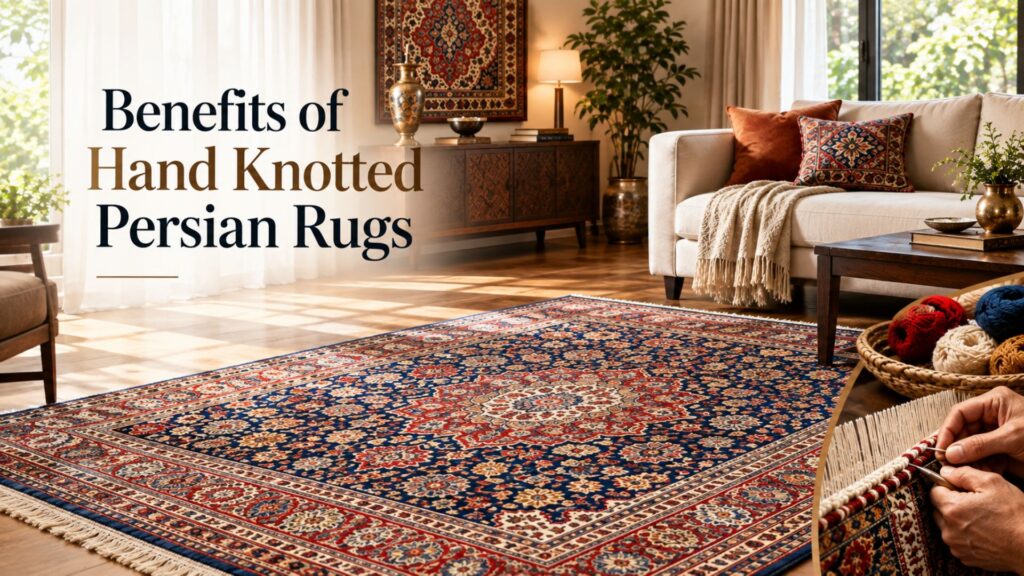
Hand knotted Persian rugs are more than decorative floor coverings. Each rug is made by tying individual knots by hand, creating a piece that reflects traditional craftsmanship, detailed design, and years of skilled work. Unlike factory-made rugs, every hand knotted rug has its own character, texture, and visual details.
For homeowners, collectors, interior designers, and anyone looking for a distinctive floor covering, the benefits of hand knotted Persian rugs go beyond appearance. Their craftsmanship, durability, materials, intricate patterns, and timeless character make them an important part of traditional rug making.
At Safa Carpet Gallery, our focus on Persian carpets reflects an appreciation for this traditional craftsmanship and the details that make handmade rugs different from mass-produced alternatives.
Hand knotted Persian rugs are traditionally made by tying individual knots around the foundation of the rug. The process requires considerable time and skilled workmanship because the design is built gradually, knot by knot.
The foundation generally consists of warp and weft threads, while the pile is created by tying knots and trimming the pile to the desired height. Depending on the rug, the materials, knot structure, pattern, size, and craftsmanship can vary considerably.
This handmade process is one of the main reasons why no two traditional rugs are exactly alike.
For buyers interested in understanding the construction of these rugs in more detail, the Safa Carpet Gallery guide What Are Hand Knotted Persian Rugs? provides a useful introduction to their construction and characteristics.
One of the most important benefits of hand knotted Persian rugs is their craftsmanship.
Unlike machine-made rugs, where automated equipment produces the pattern and structure, a hand knotted rug is created through individual knots. The weaver follows the design carefully while building the rug row by row.
This process can create subtle variations in pattern, texture, and color. These details are part of what gives handmade rugs their individual character.
For people who appreciate traditional craftsmanship, a hand knotted Persian rug can be much more than a practical household item. It can also represent a form of textile art.
Another major advantage of hand knotted Persian rugs is their construction.
Because the pile is tied directly through the foundation, a well-made hand knotted rug can have a strong and durable structure. The actual longevity of a rug depends on factors such as materials, knot quality, construction, usage, and maintenance.
A high-quality rug that is properly cared for can remain in use for many years.
This makes hand knotted Persian rugs suitable for spaces where buyers want a rug that combines decorative appeal with long-term usability.
Every handmade rug can have its own visual identity.
Persian rug traditions include a wide variety of floral motifs, geometric patterns, medallions, borders, pictorial scenes, and other decorative elements. The combination of pattern, color, knotting, and craftsmanship gives each rug a distinctive appearance.
This is particularly useful for interiors where the rug needs to contribute something visually meaningful rather than simply cover an empty floor.
A carefully selected Persian rug can become an important part of a room’s overall design.
Traditional hand knotted Persian rugs can be made using materials such as wool, cotton, and silk, depending on the type and quality of the rug.
The choice of material affects the rug’s texture, appearance, softness, durability, and maintenance requirements.
Wool, for example, is widely used in traditional rugs because of its practical qualities and comfortable texture. Silk can provide a finer appearance and greater visual detail, particularly in rugs where intricate patterns are important.
When buying a hand knotted Persian rug, it is therefore useful to look beyond the design and ask about the materials used in its construction.
Color is one of the defining features of Persian rug design.
Traditional Persian rugs can contain carefully balanced combinations of reds, blues, creams, golds, greens, browns, and other shades. The final appearance depends on the materials, dyes, weaving tradition, age, and design of the individual rug.
The handmade construction also allows intricate patterns to be developed through thousands of individual knots.
This level of detail can give a Persian rug considerable visual depth, allowing it to work as both a furnishing and an artistic feature.
A machine-produced rug can be manufactured repeatedly from the same design. Handmade rugs are different.
Small variations in knotting, color, texture, and pattern can occur because a person is creating the rug rather than a completely automated production process.
These characteristics can make hand knotted Persian rugs appealing to buyers who want something individual.
The rug you choose can have a character that is specific to that particular piece.
Interior trends change constantly, but traditional Persian rug designs have remained relevant across different decorating styles.
A Persian rug can complement traditional interiors while also adding warmth and contrast to contemporary spaces.
Depending on the design and color palette, a hand knotted rug can work in a living room, bedroom, study, office, hotel, or other carefully designed interior.
The key is selecting a rug whose size, pattern, colors, and proportions work naturally with the surrounding space.
The texture of a hand knotted rug can also contribute to the comfort of a room.
Natural fibers such as wool can provide a soft and comfortable surface underfoot, while the construction and pile height influence how the rug feels.
For living spaces where people spend considerable time, the combination of visual warmth and physical comfort can make a rug an important part of the interior.
Persian rugs are closely associated with a long tradition of weaving and decorative textile craftsmanship.
Buying a hand knotted Persian rug can therefore provide an opportunity to bring traditional craftsmanship into a modern interior.
For collectors and design-conscious buyers, this cultural and artistic aspect can be just as important as the rug’s practical function.
A well-made Persian rug can continue to be appreciated even as interior styles change.
Its design, craftsmanship, materials, condition, origin, and age can all influence how it is perceived over time. However, not every hand knotted rug should automatically be considered an investment or collectible piece.
Buyers should evaluate the individual rug rather than assuming that handmade construction alone determines its future value.
The difference between hand knotted and machine-made rugs begins with how they are constructed.
A hand knotted rug is created knot by knot by a skilled maker, while a machine-made rug is produced using automated manufacturing equipment.
This difference can affect construction, texture, design details, production time, and the overall character of the finished rug.
| Feature | Hand Knotted Persian Rugs | Machine Made Rugs |
|---|---|---|
| Construction | Individual knots made by hand | Automated manufacturing |
| Design | Handmade and often highly detailed | Machine-produced |
| Individual character | Natural variations can occur | More uniform |
| Production time | Usually considerably longer | Generally faster |
| Craftsmanship | Requires skilled manual work | Primarily machine-based |
| Materials | Can include wool, cotton, silk and others | Depends on manufacturer |
| Appearance | Often has distinctive handmade character | Usually more consistent |
Neither construction method is automatically suitable for every buyer. The right choice depends on your interior, budget, preferred appearance, intended use, and expectations for the rug.
When looking for hand knotted Persian rugs, don’t focus only on the design.
Consider several elements together:
Look at the back of the rug and examine the knot structure. Consistent, well-executed knotting can provide useful information about how the rug was made.
Ask whether the rug is made from wool, silk, cotton, or a combination of materials. Material quality can have a significant effect on appearance and durability.
Look carefully at the pattern, borders, motifs, and color combinations. A rug should work with your interior rather than simply look attractive on its own.
Measure the intended space before buying. A beautiful rug can still look unsuitable if the proportions are wrong for the room.
For older or antique rugs, inspect the pile, foundation, edges, fringes, and any signs of previous repairs or wear.
The overall quality of knotting, finishing, edges, and pattern execution should be considered together.
For buyers exploring different Persian rug options, Safa Carpet Gallery’s Persian rug collection can help you compare different styles and characteristics before making a decision.
Good care can help maintain the appearance and condition of a hand knotted rug.
Regular but gentle cleaning, careful placement, protection from excessive moisture, and appropriate professional cleaning can all help.
Avoid treating an expensive handmade rug like an ordinary machine-made floor mat. Strong chemicals, aggressive scrubbing, excessive moisture, or unsuitable cleaning methods can damage fibers and colors.
For stains or deeper cleaning requirements, professional rug cleaning and repair can be a safer option, particularly for valuable or antique Persian rugs.
The answer depends on what you expect from a rug.
If you are looking primarily for the lowest-cost floor covering, a machine-made rug may meet your needs. But if you value handmade craftsmanship, distinctive designs, traditional construction, natural materials, and long-term decorative appeal, hand knotted Persian rugs offer characteristics that mass-produced rugs cannot reproduce in exactly the same way.
The most important step is choosing the right rug for your space, lifestyle, budget, and expectations.
At Safa Carpet Gallery, the focus is on helping buyers appreciate the craftsmanship and characteristics behind Persian carpets rather than viewing them simply as decorative products.
A well-made hand knotted Persian rug can be highly durable, but its lifespan depends on construction quality, materials, usage, environment, and maintenance.
They can cost more because they require substantial manual labor, skilled craftsmanship, quality materials, and considerable production time. The individual design, origin, age, condition, and quality can also affect the price.
There is no single lifespan for every rug. Construction quality, materials, traffic, cleaning, storage, and maintenance all affect longevity. Properly cared-for high-quality rugs can remain useful for many years.
Yes, depending on the rug’s construction and condition. However, placement and traffic should be considered, especially for delicate, antique, or highly valuable pieces.
Examining the back of the rug can provide useful clues. The knot structure, foundation, pattern, and finishing details can help determine how the rug was constructed. For valuable rugs, professional assessment can provide additional confidence.
Not necessarily. “Handmade” is a broad term that can include different construction methods. “Hand knotted” specifically refers to rugs made by tying individual knots by hand.
The benefits of hand knotted Persian rugs come from a combination of craftsmanship, construction, materials, design, and individuality.
Each rug represents considerable manual work, and the finished piece can bring warmth, texture, history, and visual character to an interior.
Whether you are furnishing a home, decorating a luxury space, or looking for a distinctive handmade carpet, understanding how a rug is made can help you make a more informed choice.
Safa Carpet Gallery believes that choosing a Persian rug should be about more than simply selecting a pattern. It is about understanding the craftsmanship, materials, design, and character behind the piece and finding a rug that works naturally within your space.